

Nature Chemistry - ICMol contribution reveals ligand-free nickel anion complex
Nature Chemistry publication with ICMol participation reports a molecular complex featuring a ligand-free nickel anion
The Institute of Molecular Science (ICMol) is pleased to announce the publication of a high-impact article in the prestigious journal Nature Chemistry, the result of an international collaboration between research institutions in China and Spain, with the prominent contribution of Professor Eugenio Coronado, Director of ICMol.
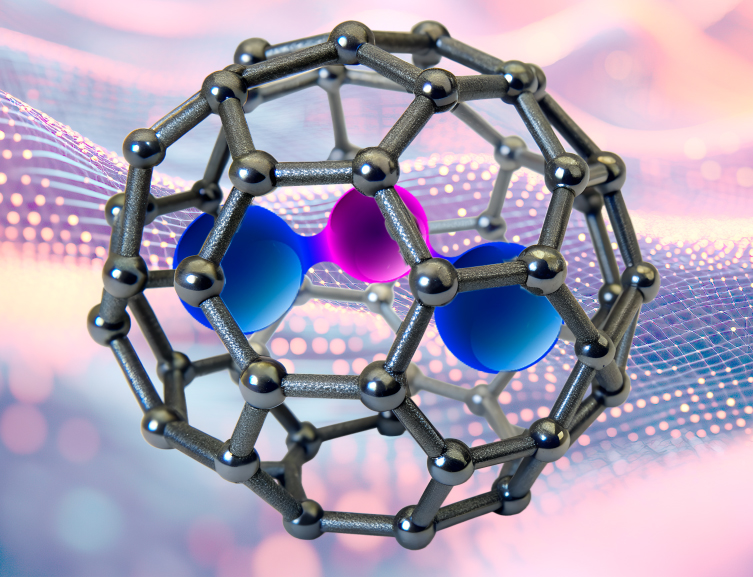
The study, entitled “Lanthanide–nickel molecular intermetallic complexes featuring a ligand-free Ni²⁻ anion in endohedral fullerenes”, presents a breakthrough in transition metal chemistry by successfully isolating and stabilizing a nickel anion in the −2 oxidation state (Ni²⁻)—an extremely rare and challenging species to obtain under standard conditions—confined within a carbon fullerene cage (C₈₂).
Specifically, the researchers have synthesized intermetallic complexes containing a Tb₂Ni cluster encapsulated inside a C₈₂ nanostructure, resulting in the molecular compound Tb₂Ni@C₈₂. The core innovation of this work lies in the spatial confinement of the ligand-free Ni²⁻ anion—a strategy that not only enables its stabilization but also challenges conventional paradigms of coordination chemistry and transition metal reactivity.
Using a combination of advanced techniques, including X-ray absorption spectroscopy and multireference theoretical calculations, the team confirmed that the nickel atom retains its −2 oxidation state, forming strongly polarized covalent bonds with the surrounding terbium atoms. This discovery offers a new conceptual framework for understanding and designing nucleophilic transition-metal species with potential applications in catalysis, molecular materials, and quantum technologies.
The significance of this work extends beyond the isolation of such an unusual anion; it also highlights the innovative use of fullerenes as “molecular cages” to protect and study highly reactive chemical species. This approach represents a powerful tool for exploring new frontiers in supramolecular and inorganic chemistry.
Professor Coronado’s participation reinforces ICMol’s leadership in cutting-edge research and underscores the institute’s strong commitment to international collaboration and scientific excellence. This contribution aligns with ICMol’s strategic focus on developing new molecular nanomaterials with advanced electronic and magnetic properties.
Read the full article here: https://www.nature.com/articles/s41557-025-01802-2
.jpg)