

ICMol develops a new method that improves the properties of molecular materials
Researchers at the Institute of Molecular Science (ICMol) of the University of Valencia have developed a new strategy to design metal–organic molecular materials (MOFs) in a cleaner, more precise, and more efficient way. The work, published in the journal Advanced Materials, presents an innovative method to introduce controlled defects into crystalline MOFs without the need for solvents or complex chemical processes.
Defects, far from being undesirable imperfections, can be a powerful tool for modifying and improving a material’s properties. In fields such as catalysis, energy storage, or gas separation, introducing “vacancies” or atomic-scale voids makes it possible to create materials that are more reactive, selective, or functional. The key challenge lies in controlling these defects precisely and reproducibly.
The study focuses on so-called metal–organic frameworks (MOFs), a family of porous materials formed by metal ions linked together by organic molecules. Thanks to their highly ordered and tunable structure, MOFs are ideal candidates for applications in sustainable chemistry, sensing, and catalysis.
Traditionally, defects in these materials are introduced in solution, taking advantage of the fact that the bonds between components can break and reform. However, this approach has several limitations: defects can “self-heal,” they appear in an uncontrolled manner, and their generation requires the use of solvents and/or additional chemical agents.
Heat instead of solvents
The approach proposed by the team led by researchers Víctor Rubio Giménez, Sergio Tatay, and Carlos Martí Gastaldo from the FUNIMAT – Functional Inorganic Materials – group at ICMol is radically different. Instead of working in solution, the method relies exclusively on heat to selectively remove part of the organic molecules that hold the material together. These neutral and volatile molecules transition to the gas phase upon heating, leaving behind perfectly defined voids within the crystalline structure.
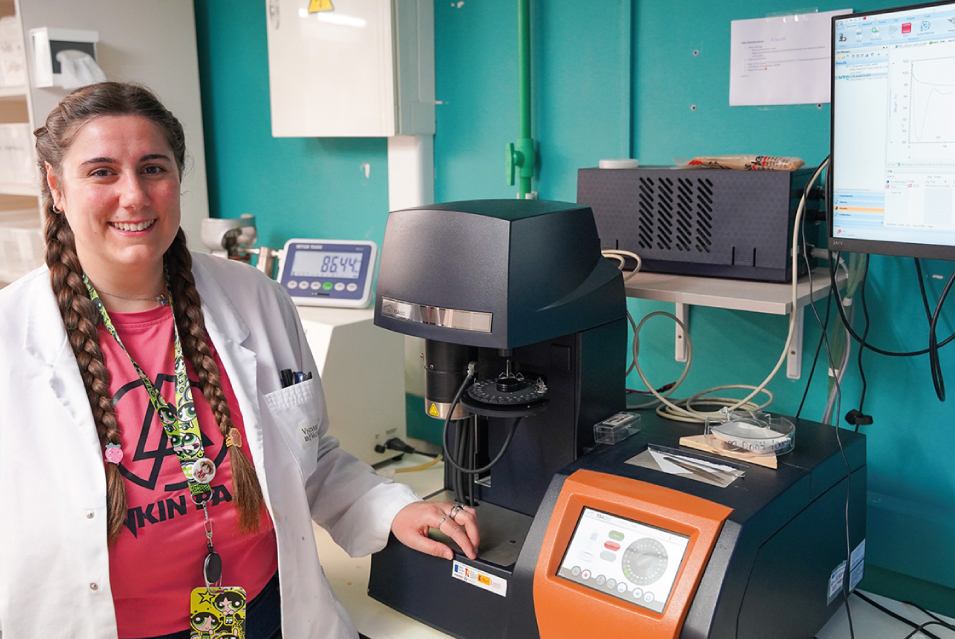
The process is carried out using a piece of equipment commonly found in many laboratories—a thermogravimetric analyzer—and allows for highly precise control over how many of these volatile molecules are removed. In this way, researchers can finely tune the number of defects generated, from very low levels to the complete removal of these linkers, in a fully reproducible manner and without the use of solvents.
One of the most remarkable outcomes of the study is that the created voids give rise to “open” metal centers—iron atoms that remain partially coordinated while maintaining a stable +2 oxidation state, even when exposed to air. These centers can act as active catalytic sites capable of accelerating chemical reactions.
Furthermore, the presence of defects alters—but does not completely destroy—the original material’s key physical properties, such as porosity and magnetic behavior, demonstrating the viability of this strategy.
Towards more sustainable materials chemistry
In this context, Sonia Martínez Giménez, the first author of the article, highlights that “the value of this method lies in its ability to modulate material properties in a highly controlled way while avoiding the use of solvents and additional chemical processes,” representing an advance both in materials design and in process sustainability. This strategy could be extended to other MOFs and molecular frameworks, opening new pathways to materials with tailor-made properties for energy, industrial, or environmental applications.
The work reinforces the role of the Institute of Molecular Science of the University of Valencia as an international reference in the rational design of functional materials and in the development of new strategies for a more efficient and sustainable science.
Article reference:
S. Martínez-Giménez, A. Orellana-Silla, M. Galbiati, et al.
“Solvent-Free Thermal Defect Engineering in Molecular Frameworks With Volatile Linkers.”
Advanced Materials (2025): e11250.
https://doi.org/10.1002/adma.202511250
Categories:
Institute of Molecular Science (ICMol), Research, Innovation and Knowledge Transfer, Research at the University of Valencia, Research Funding, Scientific Output, Science Communication and Outreach, Scientific Culture, Research Internationalization
.jpg)