

ICMol is shaping the future of quantum communications
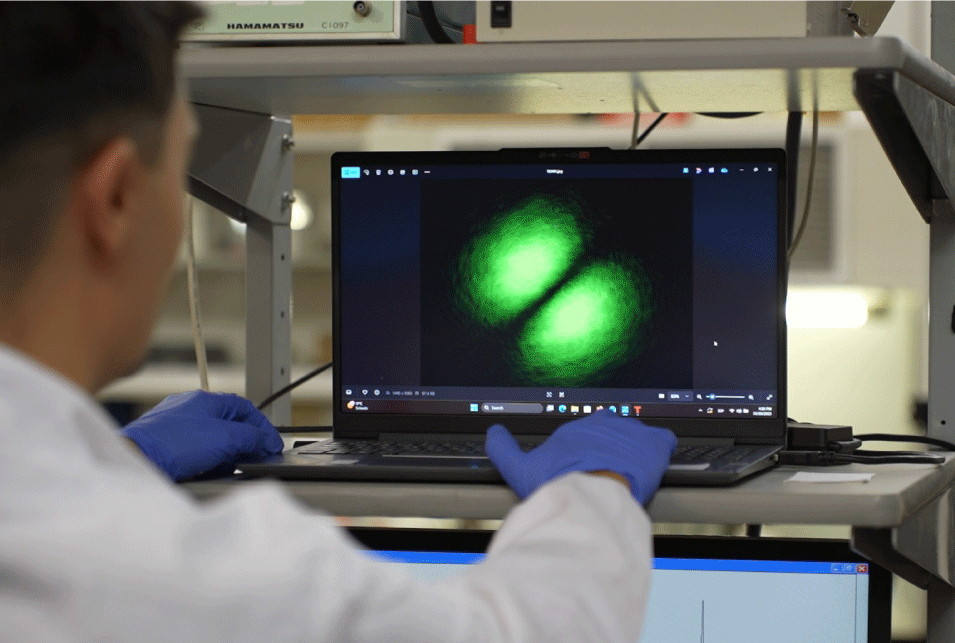
The Universitat de València promotes quantum technologies to strengthen communications security
- The QDIMENSION initiative investigates new ways of communicating information, anticipating the security and reliability challenges posed by digital transformation
- The project is part of the Comunitat Valenciana Quantum Communications Plan, involving four Valencian universities
Digital transformation poses new challenges in the way information is transmitted, increasingly linked to the security, efficiency, and reliability of communications. In this context, the Universitat de València (UV) is advancing its commitment to cutting-edge research through QDIMENSION, a project focused on the development of quantum communication technologies—an area set to transform how information is transmitted and protected in the coming years.
“This project was born with the aim of advancing technologies that enable more secure and efficient communications. Our goal is to invent new tools for quantum information processing,” explained Mauricio Morais, leader of the research line on acousto-optic modulators.
The initiative seeks to address one of today’s major technological challenges: how to transmit information in an increasingly secure, reliable, and efficient way within an ever more complex digital environment. The work carried out by the Universitat de València is based on new tools that allow the exploration of alternative ways of processing information, laying the foundations for a new generation of communication systems.
The project is part of the Comunitat Valenciana Quantum Communications Plan, a joint strategy involving, in addition to the Universitat de València, the Universitat Politècnica de València, the Universidad de Alicante, and the Universidad CEU Cardenal Herrera. These four universities, working collaboratively, are driving a new wave of innovation to position the Comunitat Valenciana as a benchmark in quantum technologies applied to strategic fields such as telecommunications, cybersecurity, and health.
Since 2018, the European Commission has intensified its support for the development of quantum technologies through specific research programmes. This commitment is based on the conviction that these technologies can bring about profound changes at both industrial and scientific levels, with a direct impact on society. This context has given rise to what is now known as the “second quantum revolution,” a phase in which research is beginning to translate into concrete and applicable solutions.
The QDIMENSION project aligns with this European vision and works to overcome some of the current technological limitations, facilitating the transition of scientific advances into real-world applications. Quantum communication may still sound distant to many people, but research is already underway to integrate it into systems that can be used in everyday life. “The fabrication of integrated quantum photonic devices requires new methods for positioning single-photon emitters. In QDIMENSION, we have developed different strategies that make it possible to isolate quantum emitters with nanometric precision,” noted Josep Canet, principal investigator.
The scientific work is structured in different phases that enable progressive advances in the development of new devices, analysis systems, and information-processing methods. This approach makes it possible to evaluate results, improve processes, and explore new possibilities as the project progresses.
A university looking to the future through research
This project is one of eleven that make up the Quantum Communications Plan, led by four prestigious universities: the Universitat Politècnica de València (UPV), the Universitat de València (UV), the Universidad de Alicante (UA), and the Universidad CEU Cardenal Herrera (CEU-UCH). Together, these initiatives cover a wide range of research and development lines aimed at promoting quantum technology and its applications in strategic areas such as telecommunications and cybersecurity, thereby consolidating the Comunitat Valenciana as a benchmark for technological innovation at both national and international levels.
With more than five centuries of history, the Universitat de València has established itself as a leading institution in research, teaching, and knowledge transfer. Its participation in the Quantum Communications Plan reinforces its commitment to scientific excellence and innovation, positioning the Comunitat Valenciana as a hub for technological and scientific development at national and international levels.
“Quantum optics is not just a matter of the future, but of the present. Projects like this strengthen the role of the university as a space where solutions to upcoming technological challenges are anticipated,” concluded Guillermo Muñoz, leader of the research line on polaritons.
About the Valencian Quantum Communications Plan
The Complementary Quantum Communications Plan is part of the EU Resilience Plan and has a total budget of €76 million. The plan aims to promote research and development in the field of quantum communications, a key technology for the future of telecommunications.
The Comunitat Valenciana has been participating in this project since 2022, along with Castilla y León, Catalonia, the Basque Country, Galicia, and the Community of Madrid, as well as the Consejo Superior de Investigaciones Científicas (CSIC).
In the case of the Comunitat Valenciana, most of the funding comes from the Ministerio de Ciencia, Innovación y Universidades, which provides 65% of the funds (€1,169,671.10), while the remaining 35% (€629,822.90) is financed by the Conselleria de Educación, Cultura, Universidades y Empleo.
.jpg)